Streets With Their Own Rhythm
Across Europe's rugged interior valleys, ancient stone settlements adapt seamlessly to vertical rock faces and river loops. Here is our field survey of communities where architecture and geology fuse into unforgettable photographic frames.
Find a fresh frameGeological Masterpieces
Traditional builders throughout Europe did not clear the land to impose foreign blueprints; they harvested the bedrock immediately beneath their boots.
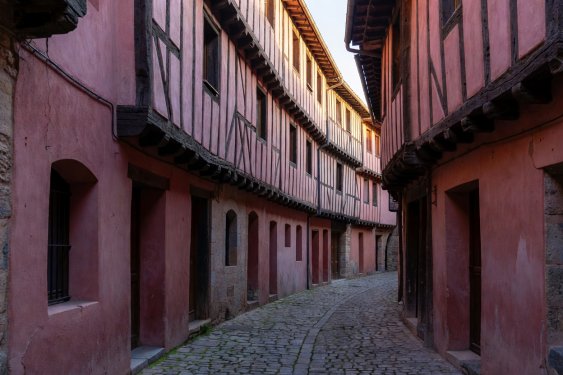
Albarracín: The Pink Stone of Teruel
Cradled in a deep bend of the Guadalaviar River, Albarracín's narrow lanes lean outward toward each other as they ascend, with upper eaves nearly touching across the cobblestones. The distinct reddish plaster, created from iron-rich local clay, produces a luminous amber hue in early morning side-light that contrasts sharply with the arid limestone ridge above.
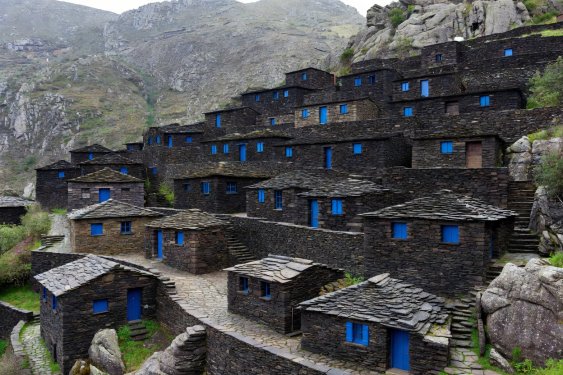
Piódão: The Amphitheatre of Schist
Constructed entirely from dark crystalline schist with blue painted timber doorways, Piódão cascades down the steep terraces of the Serra do Açor like an ancient amphitheatre. During overcast or rainy conditions, the wet stone glints like polished charcoal, giving the village an introspective, cinematic mood rarely found in standard sun-drenched holiday brochures.
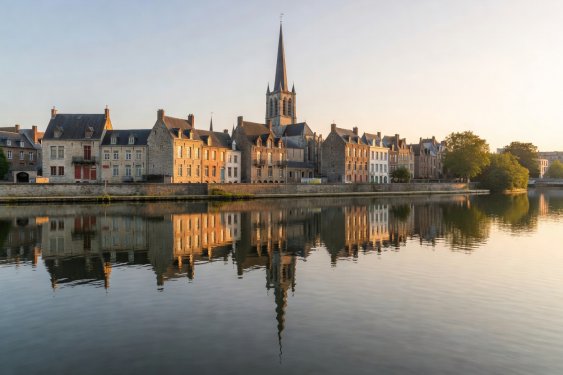
Dinant: The Sheer Wall of Wallonia
Squeezed against a vertical cliff on the banks of the River Meuse, Dinant's dramatic geometry is commanded by the Collegiate Church of Our Lady and the high citadel fortress. The still waters of the river in late October provide mirror reflections in the twilight blue hour, while warm street lanterns accent the Gothic masonry.
Visual Characteristics of Europe's Stone Hamlets
A reference matrix of regional building materials and optimal photographic lighting angles.
| Village & Region | Primary Stone Type | Visual Signature | Recommended Sun Elevation | Compositional Focus |
|---|---|---|---|---|
| Albarracín (Spain) | Iron-tinted gypsum & timber | Cantilevered upper floors | Low sunrise (10°–25°) | Converging alley perspective |
| Monsanto (Portugal) | Porphyritic Granite boulders | Cyclopean rocks wedged in roofs | Mid-morning side light | Scale of natural rock vs masonry |
| Piódão (Portugal) | Dark Schist & slate | Cascading tiered terraces | Overcast diffuse or dusk | Deep monochromatic contrast |
| Civita di Bagnoregio (Italy) | Volcanic Tuff on clay | Solitary elevated plateau | Dawn inversion layer | Isolated horizon silhouette |
| Dinant (Belgium) | Carboniferous Limestone | Sheer rock face backdrop | Late evening blue hour | Reflective water symmetry |
Observing Rural European Architecture With Care
When documenting historic rural settlements, photographers often overlook the delicate operational reality of these villages. Many of these towns have year-round resident populations of fewer than 300 citizens, predominantly seniors who maintain the fragile infrastructure.
A good photograph tells a story of craftsmanship and endurance, rather than treating an active town as an empty cinematic playground. Spend time observing where natural paths lead, how the local irrigation fountains function, and take time to engage respectfully with the craftspeople who preserve these stone traditions.